 |


|
 |
Archive for Posts Tagged ‘business’
October 12th, 2009 by Amelia G
Edit: I was just feeling glum because someone I respect wrote something I wish were true, which I do not believe is true. I don’t feel like I was able to fully express my thoughts on this.
Full disclosure: Bing is an advertiser on this site, yet BlueBlood.net does not on the first dozen pages of search results for a search on Blue Blood. SEO stands for search engine optimization. SEO is internet professional lingo for the process by which someone expert in this area would attempt to fix Bing’s search results so they would no longer be defective in this regard.
I’ve been really bummed out all day because of something Derek Powazek wrote. (Also, I made the mistake of watching this week’s brilliant but melancholy Mad Men on TiVo to snap myself out of it. Doh.) Halcyon first turned me on to Derek Powazek’s writing. Derek Powazek tends to write useful articles about how to make good web sites. He has an engaging style and manages to speak clear tech talk. I think we shook hands once at an event, but we do not know each other; I’m just a fan.
Entertainment industry professionals always used to joke with me and Forrest Black about Blue Blood in print being the “trade mag of cool”, maybe because we always found the next big thing and provided contact info. I suppose I’d be wildly wealthy today if I’d just marketed myself as a consultant and charged quite a bit more for that data than the price of a magazine. My focus, however, was just on making a good magazine. One of the coolest things about making a magazine, versus making a website, is that I could just mail anyone I thought was cool a free one. I never felt like I needed fancy press releases. I could just show what I created to people I respected and hope they liked it. I didn’t know it until years too late for this to be useful to me, but Blue Blood was far and away the highest circulation magazine in its niche. So I guess that all worked just fine, in some respects. But, for a web site, this becomes a lot more challenging because previously normal human journalists may freak out that they are being spammed when sent a press release, as opposed to physical freebies.
Here is where Derek Powazek’s “Spammers, Evildoers, and Opportunists” article really depressed me. His advice is to never SEO (see the witty title there). His article states that SEO does not work and also, because it works temporarily, it clogs up search engine results. (I think he should pick which is the problem.) He directs his readers to avoid making sites for Google and just make good web sites for one’s readers and tell people you know personally about them.
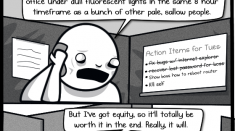
So here is why the “Spammers, Evildoers, and Opportunists” article really upset me. The whole time I was growing up, it was drummed into me that I absolutely had to get good grades and go to good schools, so I could get a good job and a good life. Okay, both my parents went to Harvard and I went to Wesleyan, but Wes is still one of the top universities in the country on all ranking lists. And that paired with a hot suit will get me a job as a nonsexual escort. Escorting is actually the only job I’ve ever done which required me to have an advanced education. As writing about that job for Hustler’s Chic got me my first non-music glossy magazine clip, I supposed I’ve arguably gotten two jobs for all those years of school. Kind of a sucky ROI.
But I digress. The point is that I was told to just work hard and do what I was supposed to do and I would be rewarded. And I fucking well wasn’t. So it upsets me being told once again that I need to just work hard and do what I’m supposed to do and I will be rewarded. I mean, I still do that because it’s just how I am wired at this point. Like the characters on Mad Men, there is a thin patina of mild disappointment on a lot of my experiences, but I no longer get wildly, dramatically, heart-breakingly disappointed, because I stopped believing my reward was just around the corner and would be given just for making something good which people liked.
In point of fact, for example, I work very hard on making BlueBlood.com a good site. But I spend my time creating and publishing content the readers will enjoy, not optimizing for Google or Yahoo or Bing. BlueBlood.com never makes the front page of Google for a freaking search for Blue Blood. This makes doing radio and TV shows much less beneficial than it should be. That site has actually only received 844 visits from Google total this month. And 143 of those were people searching for specifically blueblood.com. I don’t get why someone would type that into a search engine, but the point is that just working hard and doing good work are absolutely not enough. I would love it if someone from Google could explain why the heck that site is never indexed properly. Thank goodness I have extensive traffic resources outside of what search engines provide. And I work hard on those too. It makes me viscerally angry to see Twitter lighting up with venture capital rich tech gurus saying everyone else should just work hard, tell their friends they’re working on cool stuff, and sit around waiting for something good to happen. The Underpants Gnomes on South Park have a waaaaay better business plan.
I like to do the right thing and I enjoy working hard. But I am well aware that I pay a heavy price for the luxury of doing what I feel is the right thing on the road less traveled. And I am sick to death of being advised to keep doing the same thing while expecting different results.
19 Comments »
July 20th, 2009 by Steven Archer
For some reason I have been having this discussion over and over lately, the most recent being with my buddy the truly awesome musician Dan Clark about the problems of getting your band booked. Based largely on my experiences touring with Ego Likeness, here are some of my thoughts on the whole business of getting booked . . .
There are several problems with bands getting shows.
1. The most obvious, yet the least talked about: The band needs to be desirable. Does the band bring *anything* to the table, do they have a fan base? Most of the time the answer is no. And on the occasions the answer is yes, it’s best to assume it is smaller than you think it is.
1a. Most bands are far more interested in playing shows than making fans. Many bands believe they are good, and believe that because they are good people will give them a chance, and give them shows. I see a lot of bands trying to go on tour that are just not ready for it. I mean you can do it, don’t get me wrong, but chances are you will play a bunch of random bars, for no one. You might score a hit here and there, but more than likely you will just bleed money.
So lets say they manage to book a show in an unknown market. No one shows up, because no one local knows who they are, and the promoter loses.
If the band is lucky the promoter might set them up opening for a good local act, and they might get a toehold in that market. But as there are a ton of bands vying for that position it is difficult at best to acquire.
1b. So how do you go about getting a toehold? SPEND MONEY!! Make a good CD, with good songs, then when you manufacture it, send out 20 copies to any general club that might book you. Send T-shirts, stickers, anything you can, as much as you can. So lets say you send out 1,000 CDs, out of those 1,000, 100 get listened to, but it is something. That is your toehold. I am not talking about press kits, or digital downloads; I am talking about physical free stuff. Everyone has free promo downloads, but no one is going to download something from some random band they have never heard of. However, some people will put in a CD by a band they have never heard of, particularly if that CD looks nice and is accompanied by other swag.
2. There are few actual promoters who understand the business. If a promoter loses money on a show, it is their fault, period. They need to have a realistic (not what they want) understanding of the draw of any given act. They need to put that act in a room of the appropriate size and the appropriate cost. If the band wants too high a guarantee, don’t take the gig. If the only available show date is a Monday night, don’t take the gig. If you do take the gig, because they are your favorite band, be prepared to take a loss.
Actually that is a good rule across the board, always assume that any show you have will lose money. If it doesn’t, bonus!
It is always better to pack a tiny room than play in a 200 person room to 50 people.
3. Bands on the other hand need to be realistic about their guarantees. It doesn’t matter how popular you think you are or how popular you should be, because you are you and you are good, dammit. The reality is that, unless you have been around a very very long time, or have had a documented club hit, you should not be asking for a guarantee over say $100, if that.
Let’s say you have a tour and the average guarantee you ask for is $100; that’s really low, and most promoters can make that back. Awesome! Because the next time, hopefully you can ask for more. However, if you are a promoter’s favorite band, and you take advantage of that by asking $500 and the promoter loses money, they probably won’t have you back. The idea everyone involved needs to embrace is longevity, not any individual show or tour.
4. Bands, if you cant afford to tour without getting $3-400 a show, and you do not meet the above criteria, DON’T FUCKING TOUR!! Or trim your machine down to the point where you can do it for $100-200 a show, less if you can. More people in your band does not make a better band, it just makes more mouths to feed and, and a higher cost. This scene in particular is very forgiving of two people and backing tracks (we know from experience) *IF* that is you can put on a good show with good songs. No amount of gear or number of bodies on stage will help you if your songs are not good or you don’t somehow connect with the audience.
The audience does not care about your gear or the number of people onstage. They care about the band that loves making music, and loves performing no matter how many people are there.
If everyone involved has a reasonable understanding of what to expect, then a successful show is much more likely.
I guess what it boils down to is this.
Promoters
Don’t book shows that cost more than you can afford to lose.
Always assume that no one will show up, and you are booking the show for yourself.
Never assume you know what kind of numbers a band will draw.
No matter who the band is, you need to promote the hell out of the show.
Don’t let bands take advantage of you. If a band wants a bunch of rare alcohol or whatever, fuck ‘em. Requests like that tend to be insulting to all involved.
Bands
Do not charge more than you are worth.
Do not ask for anything from the promoter except items required for a quality show.
Do not mistake internet popularity for actual bodies.
Just because you made something doesn’t mean its good.
You probably have too many people in your live act, get rid of some.
For that matter, get rid of anything that you take on tour that does not make you money.
When you are pricing your tour, do not forget that promoters also have to pay for sound people, PA’s, venues, promotion, food, etc. The cost of a show is not just your guarantee.
Always assume that no one cares about what you do, and plan on living off the bare minimum.
Then if you are wrong, everyone wins. But going into any business situation assuming you are owed anything is fatal for everyone involved.
One of my favorite quotes that kinda puts it all in perspective: “Pigs get fat; hogs get slaughtered”
11 Comments »
January 25th, 2009 by Amelia G
So, Forrest Black and I just went for coffee. Well, it was Starbucks, so he went for coffee and I went for ice water and conversation. I was just reading a thing about how Warren Buffet built his business and wanted to talk about some of the interesting ways he approached things. So we are talking about how insurance companies invest with your premiums and that is where most of their profits come from, and how Warren Buffet’s primary holding company Berkshire Hathaway actually failed at its primary business and no longer actually produces anything to do with what the original brand was about, and various other factoids which are intriguing, if you find business structures interesting.
At a certain point, I noticed some security guards hovering kind of close to me out of the corner of my eye and wondered if Starbucks had any special rules against people with purple and green hair discussing high finance. I couldn’t think of anything particularly awful I was doing, so I went back to my conversation, but there was still this sense of bad energy. The security guards went away, but people started shouting. As some of the people shouting were Starbucks employees, I assume security fled so they would not be witnesses to the people who worked at the shopping center braining someone with a coffee pot, if that was about to ensue. These security guys know where their paychecks come from and it is not making coffee-drinkers happy.
So apparently there was a customer there who wanted foam on his coffee or crema on his espresso or something like that. The chick who took the order didn’t really understand his question, so she answered kind of noncommittally on whether or not he could get what he wanted. When he got his order, it was not what he wanted. The barista said their machine could not do that. (This sort of thing is why I get my coffee at Intelligentsia and not Starbucks.) Instead of just apologizing to the guy and giving him his money back with a coupon, as Starbucks used to do when they were a better stock to own, the chick who took the order started screaming at the guy that he should have listened to her when he placed his order. So this dude who was behind the counter but seemed too young and clueless to be a manager came over to try to help, but, by this time, the customer was yelling about his “shitty” service and making a huge scene, while the line got really backed up with people waiting to order. The Starbucks dude, who was hopefully not a manager, took a stab at trying to calm things down, but he had this kinda rude grin on his face the whole time and seemed like he was laughing at the customer. He may have just been nervous, but it really did not help. The Starbucks at Western and Hollywood used to have a really awesome cool manager who we liked enough to give free gifts when we ran into him at a convention Blue Blood was exhibiting at, but Starbucks moved him to Vermont and Hollywood. I don’t even know if the Western and Hollywood Starbucks has a manager any more.
I know Forrest Black was pretty close to handing the customer five bucks himself and just asking the yelling guy to please leave. Instead, once the customer told the cashier, “you can kiss my ass” and she shrieked back, “you can kiss your own ass”, we decided to just leave that classy establishment. This is one of those moments where someone doesn’t realize how much accuracy is in what they were saying. When the Starbucks customer told the cashier to kiss his ass, on some level, what he really wanted was for her to treat him like a customer, rather than belittling him. I would have been opposed to another customer paying the angry customer to leave because I feel like that would just be paying off a terrorist and reinforcing that guy’s behavior where his yelling and expression of rage got in the way of everyone else’s coffee drinking ambiance and even coffee ordering. I thought the Starbucks employees could have handled things much more smoothly to stop the unpleasantness, but I also don’t think people should be rewarding for publicly crying like spoiled children in the cereal aisle and ruining other people’s experience.
People pay five bucks for a coffee because they want to relax. The thing I actually found kind of surprising was that the people behind the counter really did not seem to take any pride in their work or care if they did it well. I mean, Forrest Black didn’t have any problem with his order and I had not problem with mine, so it is not like they messed everything up or anything, but the folks who used to work there always seemed to want to excel.
Now I’ve worked at some pretty terrible jobs. Heck, there are days I come to work and just wish I still worked retail. Even when I have to work on something I do not enjoy, I do try to do it well though. I take pride in a job well done and try to do my best. Sometimes my best is nowhere near good enough, but I strive for excellence and take pride in putting in a good effort. Do you take pride in doing what you do well or at least putting forth a good effort to achieve the tasks at hand?
32 Comments »
|
|
 |
|
 |