Blue Blood Newswire Blue Blood Community Blue Blood Galleries Blue Blood Videos Blue Blood Links Blue Blood Newsletter Blue Blood About Us Blue Blood Contact Us Blue Blood Community Register blueblood.com
Zombie Walk

Zombieland

Vampire Con

Mad Men Season 3

Torchwood 3 Children of Earth

Masuimi Max

Blasphemy Day

Erotic BPM Lingerieve Rave

Star Trek Porn

Adrenalynn Secretary's Day

BLUEBLOOD.NET

Archive for Posts Tagged ‘matthew-weiner’

Mad Men Yourself

August 14th, 2009 by Amelia G

madmen ameliagThe new season of AMC’s Mad Men starts this Sunday. I will be at Vampire-Con, so I’ll be TiVoing it, but I’m looking forward to this new season of one of my favorite shows. Pre-season rumor has it that this time out, Mad Men creator Matthew Weiner has in store more drinking, more gender relations of both the sexual and social issue variety, and will start off a couple more years into the 1960’s.

We’ve got a beautiful Mad Men promo photo gallery for your viewing pleasure here. The colors of past seasons were a bit different from these and I can’t say whether the new season will fully match prior seasons or evolve. I love the look here, though, and one of the most impressive things about Mad Men is the hyper real look and feel. The show’s costuming is convincingly period, but somehow makes each time it covers look more fabulous and glamorous and beautiful than it probably looked at the time. The lighting and color palette is always just gorgeous and makes this one of the few shows I always TiVo at Best Quality, so I don’t miss a bit of the look and feel.

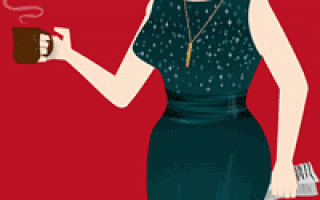
Over on the AMC site, they also have a MadMen Yourself avatar creator. The image above is the one I did for myself. There was no option for iced latte, as it would have been an anachronism in 60’s Madison Avenue, so I opted for a hot coffee. There was no option for purple hair, but I was able to select stripes.


Paul Kinsey Throws a Mad Men Hipster Shindig

August 7th, 2008 by Amelia G

Paul Kinsey Michael Gladis Mad MenIn this week’s episode of AMC’s Mad Men, the Paul Kinsey character, ably played by Michael Gladis, throws a party in his hipster Montclair loft. I’m not sure what Montclair is like today, but, when I was in school in Connecticut, I recall Montclair being mostly nice suburban homes. Definitely no longer hip and outlying. In the 1962 time of Mad Men, however, it is a transitional neighborhood which is home to its original have-nots and the adventurous vanguard of hipsters who are the frontline shock troops in any gentrification.

Paul Kinsey has invited people from all different areas of his life, hoping they will mingle with one another happily, and think better of him for throwing such a fabulous interesting party. It is a bit scandalous that, as an aspiring writer, Paul has snarfed a typewriter from work and left it on display where his guests can all see it. Some of the people from the Sterling-Cooper advertising office where he works feel uncomfortable, uneasy and unsafe in his neighborhood. Some just feel threatened by the strangeness and feel compelled to assert their alleged superiority. Paul’s ex-girlfriend, the sexually predatory office manager Joan Holloway, refuses to acknowledge that his new girlfriend is an assistant manager at a supermarket, calls her a checkout girl, makes a thing of her being black, and accuses Paul of basically trying to hard to be interesting. One of Paul’s collegiate chums fails to close the Peggy Olson character because he can’t wrap his head around the notion that a woman is a copywriter like his friend and not a secretary or receptionist. It is a very satisfying moment when she tells him that she is not going home with him because she is in the persuasion business and his presentation was unimpressive.

Damn but I have had that party. I always want to meld all the areas of my life into one. I don’t want to have to present a different face to each group of people I know. I want everyone to know the true me and somehow this feels like it means that everyone I know should be able to enjoy one another as much as I enjoy each of them.

I invited many of my friends from university and from the science fiction convention circuit to shindigs at my old punk rock group house Cambodia. Some of my school friends thought it was a great opportunity to bang a piece of strange, but they would also talk amongst themselves about what a waste it was that I was doing this instead of working for a management consulting firm or investment bank or something. Some of my punk rock friends failed to bang a piece of what would have been strange for them because it never occurred to them that someone in a buttoned down shirt could, for example, be gay. I still cringe when I remember one of my favorite people from sf fandom telling me he had the single worst time he had ever had at any party ever at Cambodia.

I thought that putting the different groups of people together would expand their horizons in an enjoyable way. My university prided itself on its diversity and I believed that diversity was simply good. Sometimes, for some people, my cross-pollinating shindigs did work out the way I hoped and intended. Writer Malcolm Gladwell, author of The Tipping Point, calls people like me connectors for introducing those who might otherwise not meet. Sometimes it is stimulating and invigorating being a connector and sometimes not so much. I try to make Blue Blood an entertainment haven for people like myself, who have wandered through many subcultures, never finding just one which was wholly who they are. Living that way, a person is likely to avoid believing the common lies people tell themselves, a person is likely to avoid believing things which are simply not true. There is a purity to this, but there is also the very real possibility of ending up feeling like a person without a country.


Mad Men New Season and Pain from an Old Wound

July 27th, 2008 by Amelia G

Don Draper Mad MenI think Mad Men was probably my favorite television show last season. The show name Mad Men is derived from the ad men who worked on Madison Avenue in New York. The first season of the show revolved around the lives of people who work at a fictional ad agency called Sterling-Cooper in 1960. Despite the fictional nature of the agency depicted, the modern ad industry trade magazine Advertising Age put together a whole fictional issue with news bites, interviews, and profiles of fictional industry professionals. That is some mighty creative marketing.

Don Draper, the primary character on the show, is always quick with a clever word and a creative approach to marketing at work and coming up with the best personal presentation personally. In describing him, one of the his coworkers says, “nobody has ever turned over that rock; he could be Batman.” So his carefully-constructed persona has worked for getting his dream job and dream house and dream woman and dream family and a number of spare dream women, but the people he knows both professionally and personally sense that Don Draper is holding back to the point where he is somewhat unknowable.

Show creator Matthew Weiner also wrote a dozen episodes of The Sopranos and produced thirty-three episodes of The Sopranos, so it should come as no surprise that his baby Mad Men is about a lot of things with interlocking multiple storylines and complex and deep characterizations. It is always difficult to make a period piece come across as both convincing and relevant, but Mad Men succeeds brilliantly. In addition the the snappy dialog and strong set design, Katherine Jane Bryant’s costume design is nothing short of amazing in its variety, beauty, and attention to detail in character development. The award winning costume designer is best known for her work on another impressive period show, David Milch’s delightfully foul-mouthed HBO western Deadwood.

Don Draper Mad MenOn a macro level, Mad Men is about a moment in time when America, as a nation, felt optimistic and almighty but was about to feel less so. Mad Men is about a place in American history where the role of women in society was in dramatic flux and the general population’s views on bigotry over race, ethnicity, religion, and sexual orientation were all changing or about to be challenged. Many historians view the early 1960’s as when the country collectively held its breath before the tumultuous late 60’s clashed with the previously ordered world of the man in the gray flannel suit. Sort of a time when everyone was waiting for the other shoe to drop.

On a micro level, Mad Men is about the ways in which human relationships make us vulnerable, force us to expose ourselves, and create strife when we want a little extra privacy. On the surface, a number of the characters look like they have perfect lives, but they all struggle to keep what they have built together. Whenever the characters in Mad Men feel envy of one another, the viewer cringes, knowing what discomfort is behind those facades. This will resonate if you have ever gone to a corporate office job and done your best to make the right impression, all the while worried that somehow people can tell that you have to make the effort to come across like they do naturally.

While pitching Kodak at Sterling-Cooper, Don Draper explains that, in Greek, nostalgia means the pain from an old wound. According to the Advertising Age, err, articles, Sterling-Cooper got the account for the Kodak slide carousel after Don Draper said, “This device isn’t a spaceship, it’s a time machine. It goes backwards, and forwards. It takes us to a place where we ache to go again. It’s not called the wheel; it’s called the carousel. It let’s us travel the way a child travels around and around, and back home again. To a place where we know are loved.” This pitch is from a man who has erased his early personal history and has no one left to share most memories with.

The two most common responses Mad Men evokes are laughter and a certain deep ache sort of pain. It is not entirely a feelgood series, but it is aesthetically lovely, verbally witty, and emotionally moving. New season starts tonight with a dateline of 1962, two years after season one ended. I hope season two can live up to the high expectations set by season one.

The conventional wisdom is that more people were forced to present a false front to the world in the early 1960’s than now. I’m not sure whether that is reality or wishful thinking, but I’m looking forward to season two of a show which makes me think about important questions like that.


Aspirations!
by Cafe_Post_Mortem
Cats are awesome
by mystoo
Babyland 1989-2009
by One Eyed Cat
Favorite Social Sites
by stevieseven
Twilight
by a_small_death
Is anyone in New Zealand?
by Amerrrr....huh?
What's everyone reading?
by Rockwulf
"normal" social behavior?
by grebo
I'm So Goth...
by Vix
Kermit always cheers me up
by nathanmbailey