|


|
 |
Archive for Posts Tagged ‘sexuality’
August 21st, 2009 by Amelia G
The brilliant Ellen Von Unwerth shot an extensive pictorial of Lady Gaga in vampire drag for Out. The exclusive Out feature is called The Lady is a Vamp. The shoot styling is credited to someone named Nicola Formichetti who is seriously talented and who Bing informs me is the creative director of Dazed and Confused and is responsible for some of the fashion in Vogue Hommes Japan, V, Arena Homme, and others, as well as of course out. Always fun to discover the work of creative people I have not come across before.
Out calls Lady Gaga “Pop’s newest — and gayest — superstar”. One of the things I like about Lady Gaga is that I feel she is someone post-orientation in her approach to sexuality. She has stated often in interviews that she is attracted to women physically but only has romantic relationships with men. I’m not sure if that makes her super-gay, but maybe I am just feeling cantankerous today about people being so bent on labeling sexuality. I do not feel that an individual’s sexuality generally belongs in a tidy little box with a label stickered on it.
Then again, from an editorial perspective, I’m pleased that Out indentifies Lady Gaga as gay, however she defines herself. Because this gave Out reason to publish a beautiful portfolio of images of Lady Gaga shot by Ellen Von Unwerth. They did a ton of different set-ups and have both black and white and color and a whole spectrum of spooky themes. Lots of vampire and gothic tropes photographed appealingly. Smoky dark eyes, coffin, sunglasses at night, blood, nudity (probably sfw nudity) fangs, and cute skeleton in combat boots. Definitely worth checking out.
20 Comments »
August 12th, 2009 by Amelia G
It is no secret that I love the vampire genre. I received Honors at Wesleyan University for my thesis on vampire legends as a paradigm for aggressive human sexuality. And I would like the record to show that I will be speaking on exactly that topic this weekend at Vampire Con in Hollywood. I’ll be taking part in the panel programming Sunday afternoon, after the movie nights, and before Vampirella’s Ball (more on this in a moment.) I’m excited that Wendi Mirabella and Lotti Pharriss Knowles have put Vampire-Con together.
The panel I am on is called Hot-Blooded: Vampires & Sexuality and is at 1pm at the Henry Fonda Theater on Hollywood Blvd. It will be moderated by David J. Skal, Author of Hollywood Gothic and V Is For Vampire: The A-Z Guide Of Everything Undead. I’m especially excited that Pam Keesey, who I’m looking forward to catching up with will be on the panel. She is the editor of multiple anthologies of lesbian vampire tales, Women Who Run with the Werewolves: Tales of Blood, Lust, and Metamorphosis, and Vamps: An Illustrated History of the Femme Fatale. Pam Keesey has a very engaging personality, has published yours truly, and once gave me a tour of Forrest Ackerman’s memorabilia collection. Other panelists are Hal Bodner, author of Bite Club: A West Hollywood Vampire Tale, filmmaker Fred Olen Ray from The Lair, actress Celeste Yarnall, best known at a vamp convention for her role in The Velvet Vampire, but who has appeared in everything from Melrose Place to Star Trek, and best-selling author, comic book writer, and filmmaker Donald F. Glut who recently directed the Elizabeth Bathory-inspired movie Blood Scarab. And we’ll be talking about vampire sex.
That evening, at the same venue, from 8:30pm to 1am, there will be Vampirella’s Ball. The music will be provided by DJ Xian and DJ Gary Calamar, music supervisor of HBO’s True Blood and KCRW radio DJ. Vampire Con describes the appropriate attire saying, “Costumes are thoroughly encouraged – Vampires, Victorian, Edwardian, Steampunk, Bohemian, Tribal, Gypsy.”
Forrest Black and I will have a location studio set up to photograph people involved in the event, revelers who most exemplify the themes of the event, and our close personal friends (i.e. not everyone, but photographic subjects best for doing press coverage on Vampire Con.) If we know you from online, please come find us on the roof Sunday night (or at my panel during the day) and say hello and where we know you from. I’m looking forward to running into tons of cool people at this event. Our favorite photos from the evening will of course appear here on BlueBlood.net.
No Comments »
June 20th, 2009 by Amelia G
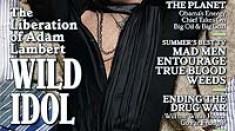
People keep asking me why I haven’t mentioned that Forrest Black and I have some of our photography of American Idol runner-up Adam Lambert in the current issues of Star Magazine and Rolling Stone, so I suppose I’ll mention it now. The internet has been abuzz for weeks now that Adam Lambert was going to “come out” in Rolling Stone issue 1081. So many publications were reporting that Rolling Stone was going to report that Adam Lambert says he is gay that Rolling Stone had to rush to put the digital image of the cover, lensed by brilliant top photographer Matthew Rolston, online well before the issue hit newsstands. Which seems very meta-something.
For some reason, a number of folks desperately wanted to be the primary source for settling speculation on Adam Lambert’s sexual orientation. Forrest Black and I photographed Adam Lambert kissing Brad “Cheeks” Bell. In point of fact, all of the supposedly scandalous images of Adam Lambert kissing a male were of him kissing the same guy, Brad “Cheeks” Bell. However, as many fans seems to find boy/boy smooching inconclusive and seemed to perhaps care about orientation, I didn’t want any part of anything which might hurt Adam Lambert’s chances of winning American Idol. I heart Alex Burton, my editor at Star Magazine, because the deal he and I made for the first round of images he ran was that there would be no outing of Adam Lambert in the issue and Alex Burton, my man of the Led Zeppelin tattoo, kept his word and kept the article classy and positive. Word is that Star Magazine offered Brad “Cheeks” Bell $2,000 to tell all and Cheeks declined, saying that he’d turned down higher dollar offers than that and he would only ever do a positive interview about Adam Lambert.
Unsubstantiated rumor is that Rolling Stone ponied up $50,000 for Adam Lambert to tell them his sexual preference first. Rolling Stone contributing editor Vanessa Grigoriadis, my fellow Wesleyan University alum, did a great job presenting Adam Lambert as a whole interesting person with visceral prose and probing but respectful questions. In the interview, Adam Lambert tells Vanessa Grigoriadis that he waited to come out in Rolling Stone because he felt he could express himself in context there. Some of the context, however, is that he didn’t lose his virginity (presumably to a man) until he was twenty-one and that he’d made out with girls while drunk at nightclubs and was now somewhat bi-curious about what it would be like to have sex with a woman.
Rolling Stone has always had some of the best, most incisive and most intriguing interviews of any magazine (and of course Wesleyan grads tend to be terrific writers), so it is no surprise this is a good one. But I’m left uncomfortable that the issue of a sexual label was such a big deal. I feel like we don’t have enough words to describe sexual orientation for the terms gay and straight to have much meaning.
If Adam Lambert suddenly got a girlfriend, after years of going out with the same sex, would that mean he did not count as gay any more? How about if he just occasionally fooled with really inspiring women who really got him as a person, but only had relationships with men? I realize that I travel in circles which are perhaps a bit ahead of the curve on sexual openness. But I know men who are gay-identified who sleep with women from time to time. I know women who are bi-identified who only have relationships with men but also have sex with women. I know men who are straight-identified who will have sex with men provided there is a sexual configuration of enough people for it to count as an orgy. Everyone can think of the prison example for same sex relationships among people who do not identify as gay or lesbian. Etc. I think that maybe 10% of the population is strongly hardwired to enjoy only the same gender and maybe 10% of the population is strongly hardwired to enjoy only the opposite sex. But most people, in the right situation, are more fluid than that. They might have a preference, even a strong preference, but, in the right situation, the preference won’t dictate their actions.
At any rate, I feel most human sexuality is too complex for a tidy label to be genuinely descriptive. I thought it was cool that Adam Lambert told Vanessa Grigoriadis and Rolling Stone, “I loved it that this season girls went crazy for me . . . As far as I’m concerned, it’s all hot. Just because I’m not sticking it in there doesn’t mean that I don’t find it beautiful.” There is a certain combination of flamboyance and rawness there which is the reason so many of my friends were rooting for Adam Lambert on American Idol.
And it is a flamboyance and rawness which utterly transcends sexual orientation. I think that general America is far more afraid of that rock star counterculture essence than they are of male homosexuality. Senior Blue Blood writer Will Judy made the excellent point that, although Adam Lambert was runner-up to Kris Allen, rather than winner, on American Idol, “Lambert got to live my ultimate superdream from 5th grade though. Fronted Kiss AND Queen in the same night. (And KILLED, of course)” which is a really fine summation.
7 Comments »
May 18th, 2009 by Amelia G
If you are alt-identified, yet want Kris Allen to beat Adam Lambert in this week’s American Idol finale, then you are complicit in your own oppression. Rebels who want Adam Lambert to lose must just hate themselves.
People like to fuss about sex and sexuality, but the place where Adam Lambert is actually unusual is that it is rare to see new musicians with serious larger-than-life star quality in the spotlight today. I just watched a top 20 video countdown and Eminem was just about the only one who would turn heads in a room he walked into, on force of presence alone. So it is exciting to see someone who has the right counterculture vibe with a mix of subcultures gothic, punk, hard rock, rockabilly, emo, scene and more blended together for something unique and compelling. To anyone who states people like Adam Lambert are a dime a dozen and FOX is just not in-the-know, I have to say there are a lot of people with some of that general sort of style, but not a lot with that vibe and that level of both charisma and musical talent.
To receive the same kudos as someone who comes across more normal and mainstream, I often feel like I have to work at least twice as hard and produce work which is twice as good. I would be fine with this, except for the part where the whole process plateaus early. Allow me to explain. In a way, simple badges of flamboyance and theoretical nonconformity, such as tattoos or unnatural hair color, have become fairly common by 2009. Someone who truly has an artistic and offbeat spirit is still likely to have to be better than the next guy to achieve the same recognition. Unfortunately, people, who identify as somehow alternative or creative or freaky, tend to want to root for the underdog. This means that, as soon as one of their compatriots is about to come over the top and succeed for real, they get an enormous backlash from former supporters. So I see all these people, who were super excited by Adam Lambert’s early successed on American Idol, who are now not into him because he is perceived as the obvious front-runner; they think maybe they like the other final two member Kris Allen because he is the underdog.
Kris Allen is an appealing enough performer. In particular, I liked his performances of “She Works Hard for the Money” and “Heartless”. I most likely would not flip the channel if a music video of his came on. I actually think American Idol fans got it exactly right for the AI8 final two to be Kris Allen and Adam Lambert. (Alison Iraheta might be more demographically similar to Adam Lambert, but Kris Allen is a more ready-for-primetime performer.) Kris Allen is not the underdog to win this contest because he is somehow disadvantaged and just needs a little love and support. Kris Allen is not some sort of stray spaniel puppy in need of a home. Kris Allen is the underdog to win the American Idol competition because Adam Lambert deserves it far far far more than he does. Some of the web chatter about the final American Idol vote suggests more that people want to vote against Adam Lambert for being successful more than they want to vote for Kris Allen for any positive reason.
Opinionated and forthright judge Simon Cowell has stated in interviews that he would like to see Adam Lambert win. Led Zeppelin does not normally permit American Idol to use their songs, but they gave permission for Adam Lambert to sing “Whole Lotta Love”. U2 does not normally permit American Idol to use their songs, but they gave permission for Adam Lambert to sing “One”. When Slash from GNR mentored the Idols, he posted to his Twitter that he was especially impressed by Adam Lambert. When Katy Perry performed on the show, the legend on the back of her Elvis cape read “Adam Lambert”.
It seems like if Simon Cowel, Paula Abdul, Robert Plant, Bono, Slash, Katy Perry, and a host of other notables all feel strongly that Adam Lambert should win American Idol, then he should be a shoo-in sure thing. But he is not. The reason he is not is that inexplicably hot people with smudgy eyeliner and leather jackets and big boots hate themselves. Now nonconformity does tend to get push-back from the overculture, so I understand why many bohemians do not necessarily expect to always get praise. Getting praise, however, does not mean that you lose your individuality merit badge. You should expect to be able to win people over, when they see what you are really like.
No disrespect at all to Kris Allen, but Adam Lambert deserves to win American Idol. Adam Lambert earned the win. I know, I know, rebels figured out that 19E and the powers-that-be want to have Adam Lambert win, so it would be (oi oi) rebellious to vote for Kris Allen instead. A good rebel is ready to take the power, not just cry like a baby over whoever seems to be an authority. Voting against Adam Lambert is not sticking it to the man; it is just building a glass ceiling for your tribe. Hopefully Wednesday night still ends up being a coronation for Adam Lambert.
13 Comments »
July 22nd, 2007 by Amelia G

It’s kind of funny that I love love love the aesthetic of the new Captivity movie, yet I’m kinda not cool with the subject matter. I’m not too comfortable with it being censored either, though.
I know people have been complaining, since before I was born, about violence in movies being okay, while sexuality is censored. But I have to say, why is it that if someone puts their cock in a beautiful woman’s mouth, the movie is probably going to get an X and thus limited distro and thus limited financing and production values? But dismember the same woman slowly and the discussion becomes R or NC-17? Is it really okay to broadcast horrors, the likes of which most people will never ever see in person, to seventeen-year-olds, but healthy sexuality, of a sort most people will experience, takes another year of maturing for audiences to be able to handle it? What kind of a society are we going to have when we show teenagers torture porn like Hostel before we let them see, if you can forgive me for invoking normalcy, normal sex?
Full disclosure: Obviously, you all can’t have missed the advertisements Captivity bought on a number sites I work on, including this one. And, yes, if you went to the premiere party at Los Angeles meat market Privilege, you probably spotted around half a dozen hotties you recognized from BlueBlood.com, along with various other contributors.
It bums me out, on a number of levels, that the premiere party was billed as ground-breakingly outrageous and nasty. This seems to show a simultaneous lack of respect for the performers and desire to profit from them. Although the cigarette smoke-stained off-white interior of Privilege generally plays host to more vanilla smutsters, Los Angeles has seen tattooed hotties doing BDSM once or twice before. In point of fact, the club is essentially a tent erected by where the Coconut Teazer nightclub used to stand. So that very location has probably been host to more than its share of tattooed hotties with fetish gear over the years. The most ground-breaking aspect was probably that it is unusual for a movie to not screen at its own premiere.
Anyway, both the MPAA, which rates movies, and a variety of watchdog groups have objected to Captivity’s presentation well before they started planning a premiere. After Dark Films pulled thirty of their billboards from Los Angeles and more than fourteen hundred taxi cab adverts, the creative for which featured the slogan “Capture, Confinement, Torture, Termination.” over very beautiful stylized photos of a very small portion of a scene involving a woman. I can’t emphasize enough how great the color scheme of those advertisements was. Meanwhile, the MPAA jerked the movie company around on when the film was even going to be rated. After Dark Films co-founder Courtney Solomon claims the MPAA rigmarole with Captivity is just about the MPAA maintaining their position of power. “They needed a whipping boy. They’re not about protecting parents or kids. They’re about keeping their power in Hollywood.” The upshot of this was that a schedule May 18 release date became a July 13 release date. While releasing a horror flick on Friday the 13th is always nifty, any organization which can keep audiences away from a product is scary. And not scary in an entertaining way, scary in a bad way.
A quick history lesson: The Motion Picture Association of America was founded in 1922 as a trade association. Although the initial industry concerns it dealt with had more to do with copyright and contract standardization, over the years, it has become almost synonymous with the ratings system it devised. Many industries choose to police themselves, partly out of decency, and partly out of a desire to take care of it internally before outsiders do it for them. So the MPAA ratings board determines whether a movie will receive wide release as a PG flick or the financial death knell of an NC-17. Representatives of the six major studios sit on the board. These studios includes Disney, Fox, Paramount, Sony, Universal, and Warner Brothers.
Now, the opening weekend gross for Captivity was only a bit over a million bucks, which is pretty terrible for a major studio release and brought the movie in at a ranking of #12 for domestic releases that weekend. In all fairness, the flicks Captivity was beaten out by were Harry Potter and the Order of the Phoenix, Transformers, Ratatouille, Live Free or Die Hard, License to Wed, 1408, Evan Almighty, Knocked Up, Sicko, Ocean’s Thirteen, and Fantastic Four: Rise of the Silver Surfer. Had the movie been able to open as planned, if the MPAA had not hung them up, then it might have been able to do better against the movies opening that weekend. Although a $1.4 mill opening is lackluster for any theatrical release, especially a heavily advertised one, had Captivity opened May 18 with the same total, it would have ranked #8. Then again, maybe it would have gotten its ass kicked by Shrek and Spider-Man, just like everybody else.
Part of the difficulty I have parsing out my feelings on the brouhaha is that it is difficult to figure out whether an After Dark Films release counts as a major motion picture or a plucky little guy trying to make it. Captivity is “co-released” by Lionsgate, but Lionsgate leaves all the responsibility for potentially problematic promo on After Dark’s doorstep. I’m not sure what “co-releasing” means exactly, but Lionsgate has a market capitalization of one point three five billion dollars and an estimated four hundred full time employees. Which I would not categorize as small or independent. I think it is important to note that the distro on a partner-produced movie like Captivity is a microscopic portion of the business of a behemoth like Lionsgate, which is responsible for very enjoyable and successful projects such as the Academy-award-nominated The Cooler and innovative DVD packaging and distribution for projects ranging from cutting edge fare like Weeds to cult classics like King of New York. Then again, if you inflicted the Care Bears movie on your kids, that is partly Lionsgate’s responsibility too.
According to the New York Times, Courtney Solomon, who put himself on the map by optioning Dungeons & Dragons and parlaying that into a much-lambasted directorial turn, “persuaded the director of Captivity, Roland Joffé, the much-honored filmmaker behind The Mission and The Killing Fields, to undertake reshoots. These added explicit torture, including a so-called “milkshake” scene that involves body parts and a blender, to a picture that was largely psychological in its thrust when After Dark acquired the rights to it.” Both to the New York Times and in other media outlet, Solomon chortles about what a freakshow his premiere is going to be and how upset he hopes women’s groups get about his movie. The National Organization for Women said, on the record, that they were not going to protest to give him press.
So, having delved into the issues involved, here is my summary take on it. First, if After Dark Films is looking for a modern audience for their movies, it is a bit antiquated to act like BDSM and tattoos are outrageous fringe culture. I’m sick of this sort of marginalizing nonsense from people who would like to make a dollar off of my scene. Secondly, because of the major studio makeup of the MPAA, I feel it can’t really be objective. I like having ratings on things as a viewing guide, but I dislike the way the ratings system leads to unwarranted limitations on distribution and I particularly dislike the way the current rating system encourages violence against women in place of human sexuality. It will be a chilly day in Hellywood before I deliberately view torture porn like Captivity, but I don’t think a project like that should have its success determined by whether or not its producers can convince a half dozen really biased businesspeople that violence against women is appropriate viewing for teens. Thirdly, although I kind of liked the Captivity billboards, I was personally revolted by the Saw signage at the San Diego Comic Con and I think movie producers, and everyone really, should pay attention to what they put in an advertisement people will not be able to avoid. I do not want strangers telling me what I can see in my media. I deeply believe that that becomes a slippery slope to total destruction of the free speech rights granted to all Americans by the First Amendment, but I also do not want strangers forcing me, or forcing children, to see things they do not wish to see or should not see. This means that adverts, in public places, for potentially upsetting products, should be honest about what the products are, without ramming the product down the throats of the unwilling.
I admit that, although I loved Elisha Cuthbert’s performance and character in the surprisingly awesome The Girl Next Door, I loathed her Kim Bauer character she played on 24. I thought about kicking off this article with a joke about how I thought Kiefer Sutherland’s Jack Bauer should have just let her be kept captive and tortured. Heck, that was probably the inspiration for Captivity. For me to want to watch that, however, it would really have to be one of the dungeons on Fucking Machines, where the action is consensual and female pleasure might actually be involved too.
4 Comments »
April 29th, 2007 by Amelia G
In recent years, I realize I have shied away from talking about certain topics such as feminism or sexuality or even actual products. This is kind of odd as these were certainly pretty cornerstone issues which were, not only covered in Blue Blood in the past, but were instrumental in why I wanted to do it in the first place.
I feel like feminism on the net, particularly when associated with the site genre dubiously dubbed altporn, is pretty much a mockery. The language has been so co-opted by people who don’t mean it, or even understand it, that the whole thing pretty much makes me sick. It definitely makes me want to disassociate myself from the whole thing, but do I really want to change my life and who I am because someone fake pretended to be like me? Probably not such a good idea.
One of the difficulties involved with feminist politics in 2007 is that it seems to be in vogue to attack people on a personal level, rather than to debate the issues. I see that most people deal with personal attacks by either defending their personal lives or correcting misimpressions about their personal lives. I think that people should pay attention to and debate the actual point and not deconstruct details which are merely specific to the person bringing a broader feminist or other issue up.
I think any artist has to give of themselves, to a certain extent, in order to create. But the global communication networks we live with today make it so difficult to maintain the slightest shred of privacy. Reality show programming and tabloid journalism put into the zeitgeist the notion that the world is entitled to know really personal things about anyone remotely famous. This makes me want to, not only avoid being famous, but move to a farm in Montana. The main thing which prevents me from doing this is the knowledge that it is terribly cliche for a Los Angeles person to buy a spread to get away from it all. That and the simple fact that pretty much no place today is really remote enough to truly get away from it all.
But it is difficult to talk about sex in this type of media climate while maintaining one’s personal privacy and avoiding becoming a public figure. But sharing any private moments in this world is like entering into a BDSM relationship with a room full of strangers who don’t believe in safewords. Sometimes, I believe a person should be entitled to say, hey, this is just for me and not the public. I believe in a fundamental right to privacy.
Lastly, various marketers have disseminated the notion that, if anyone you’ve heard of either endorses or slags a product, then they must be corrupt and inaccurate. These are marketers who of course utilize something called WOM or word of mouth marketing. Just one example of what this often boils down to is a solitary lonely dude posting two hundred reviews on Amazon, with sixty different usernames, of a dozen books, not one of which he read. But, if someone with an actual journalistic pedigree gives an opinion, it is often dismissed as envy because they also wrote a book or some such nonsense. Note to the world: known journalists really do tend to have more valuable opinions than anonymous posters. For real.
I could probably have written three long treatises in place of this article. My primary point here is that feminism, sexuality, and pop culture products news and reviews used to be the main things I wrote about. The current media environment is one where the producers have become cynical and manipulative and the audience has become jaded and betrayed. It is difficult to express true and heartfelt opinions, knowing that marketers may be rushing to either pirate or discredit what is said and readers may be looking for spin in all the wrong places.
So, if I sounded like a feminist, would you hold it against me? If I talked about sex and sexuality, would you feel compelled to pry beyond my comfort zone? If I reviewed products I like, would you assume it was just for the advertising dollars? If I reviewed products I don’t like, would you believe that I was just envious?
I used to be above it. Now I’m down in it. But I don’t really want to lose my voice.
19 Comments »
March 20th, 2007 by Amelia G
The sex blogger panel at SXSW was entertaining and provided food for thought, but I’ve been having trouble writing about it. I finally realized that the problem with writing about sex bloggers is the same problem bloggers have writing about sex: Specifically, sex and sexuality are very core to self, so even the most gentle critiquing of someone’s sexuality can be terribly hurtful. If any sex bloggers are wounded by what I say here, I apologize, but please keep in mind how you feel when you write about sex with a date who doesn’t like your review.
I attended the Do You Blog on the First Date? panel because Rachel Kramer Bussel was on it. With credits including Penthouse, Bust, and Punk Planet, I think of her more as a writer writer than as exactly a blogger, but she does blog very diligently about both her life and cupcakes, so she absolutely has blogging cred. Yes, I said she writes about “cupcakes” and that is not slang for some depraved sex act you are unfamiliar with. Sometimes a cupcake is just a cupcake and I can’t help loving quality food porn; it is hardwired into my system. And apparently I know now that I am not alone in my longings. Rachel Kramer Bussel’s writing is intelligent and raw. She manages to be very self-aware without injecting pounds of that fakey emo I-don’t-really-mean-it irony. No mean feat and a breath of fresh delight in the current online writing landscape. Especially in the blogosphere.
So I showed up to hear Rachel speak and found out about the other sex bloggers on the panel along the way. The moderator was Mikki Halpin who was a good SXSW selection because of her tome The Geek Handbook: User Guide and Documentation for the Geek in Your Life, although she is also a contributing editor to Glamour and known for her It’s Your World–If You Don’t Like It, Change It book of advice to teens on how to engage politically. Unless there is more than one Mikki Halpin writing from New York City, in which case I feel less informed, but that doesn’t seem super likely. She once was on People’s Court because someone’s mom sued her for putting their picture in her zine. She says Judge Wopner threw it out because the woman was bringing son on national TV, only she didn’t mention what the nature of the photograph was.
Then there was Melanie Boyer who does a dating blog called About Last Night for the Alt Weekly from my old stomping grounds, the Washington City Paper. She has great hair and big jangley earrings and lists a nice writerly assortment of life credits ranging from a Masters in International Training and Education to being a Peace Corps volunteer. She was kind enough to give me a turquoise pair of her signature boy short panties featuring her bird logo on the front and the line “a little birdie told me, About Last Night, dispatches from the morning after” inside.
Next up was Emily Listfield who does the Sex and the Single Mom blog for Redbook of all places. For some reason, I was surprised to see that Redbook was technologically ahead of the curve in the magazinosphere. I found Redbook also annoyingly on top of their pop up advertising technology and keep in mind what far reaches of the web I, uhm, surf. Emily Listfield is best known for her novels which genre-wise fall somewhere between chick lit and noir and I definitely intend to check them out.
I’m less surprised to find out that Glamour has a dating blogger Alyssa Shelasky. After all, Glamour and Wired share a corporate parent. Prior to blogging about her dates for Glamour, Alyssa Shelasky was a staffer for Us Weekly and before that apparently was so impressive a PR pitchwoman that journalists not only wrote about the products she repped, but also wrote about how awesome she was at getting them to do so.
Now you all know the cast of characters, so what are the ethics of blogging about dating? Melanie Boyer, of The Washington City Paper, said she initially thought she would get permission from each of her beaus. She says she believes men think they know the score when they don’t. So now her rule is to tell them what she does immediately and then the gloves are off once she is not seeing them any more, although she never uses names and attempts to be minimal enough on details that her guys are not easily identified. Still, she has more or less accidentally busted out at least two cheating lovers with her blog. Alyssa Shelasky, of Glamour, says that she tries not to humiliate people and to be friendly, nice, ethical, and kind, but sometimes she finds herself saying, “I would have thought you’d be flattered by that and instead they hate your guts and they’re going to therapy.” Rachel Kramer Bussel, of Penthouse Variations, agrees that people tend to “freak about little things.”
In addition to the ethics involved with the responses lovers and potential lovers may have to being blogged about, there are possible repercussions for third parties and other people’s opinions can come into play. Alyssa Shelasky worries about her parents’ response, so she won’t write about more than kissing. She initially thought her readers would be impressed if she talked about partying with Paris Hilton, but she quickly understood that they wanted to see her vulnerable, emotional, human side. Then again, she says she pretty much quits her job whenever she gets hate mail, so being her editor is probably kind of hellish. Emily Listfield’s blog is precisely about being sexual and being a single mom, but Redbook readers apparently can get a bit perturbed about her having sex at all. She understandably feels that her thirteen-year-old daughter shouldn’t know about her mother’s love life and has her friends lie such that “it gets very complicated to have that many realities out there.” She jokes that when your offspring turns thirty is the appropriate age to tell your child you blog about sex. Rachel Kramer Bussel has the luxury of blogging more for herself and thus having more control and says she will remove comments which are just mean and not constructive. She explains that “people really personalize whatever you write about and then they get affronted” and feel like they have to defend themselves.
The combination of invading the privacy of a writer’s romantic partners and having to stand behind whatever is blogged in the moment can be painful. Pretty much everyone on the the Should You Blog on the First Date? panel said they either wish they had blogged anonymously or were considering blogging anonymously. Emily Listfield feels that the anonymity of the women who comment on her blog entries gives them the freedom to really share about themselves and she feels that is a wonderful thing. Having her own name on her words makes Emily Listfield feel that her blog may be “destroying her life.” Alyssa Shelasky explains that Glamour wanted a face for the blog, someone who could promote on television and so forth, so being anonymous was not an option. She did enjoy it, however, when she got a MySpace account, despite feeling like, at twenty-nine, she was too old for it, and was surprised by the really really personal messages she received privately from readers. She felt like it was almost a group therapy evolution which made her like her blog more. Melanie Boyer says that the paper wanted journalistic integrity, so she had to use her name. Although she got a thrill from the whole “there’s that fat nerdy girl from junior high and now she’s a sex columnist” thing, she has found having her name on her blog inconvenient. In almost the same breath that Melanie Boyer makes the very astute observation that “anonymity erases integrity,” she expresses her own longing for anonymity. She doesn’t say whether she thinks her integrity would stay strong in such a situation. Rachel Kramer Bussel has considered doing an anonymous sex blog because she made the interesting observation that her friends who blog more anonymously than she does can be much more detailed without the same fear of upsetting those they blog about. It “makes you reconsider what you say when your name is on it,” she explains.
Pretty much all the sex bloggers agree that the people they blog about tend to be bummed about it and that they don’t much care for being blogged about themselves. Rachel Kramer Bussell says it felt weird to be blogged about by a peer, a woman she was in the same anthology with. Alyssa Shelasky says she hated having one of her guys, BostonBoy, stating his perspective in her comments and she also hated Gawker slagging her. Then again, she says she did get called “dating whore of Conde Nast” which might be a little brutal. Although I couldn’t find that exact phrase on the Gawker.com site, I did find a place where they had re-posted Alyssa Shelasky’s engagement announcement from a relationship which obviously didn’t work out. Ouch. In fact, she says, the only guy in six months who she dates who loved the Alyssacentric blog was on drugs, a “raging cokehead,” and she also had no trouble with a semi-homeless guy she had a three week fling with. Because he had no computer.
At this point in the panel, I apparently passed Forrest Black, who was shooting the presentation, a note which read: “MY BROTHER SHOULD MARRY SHELASKY ONLY HER FACE IS NOT HEART-SHAPED.” (For the non-Luddite savvy, note passing is a sort of low tech Twitter.) My brother is not a homeless coke addict with no computer (and I love my brother) so I guess there is just something wrong with me. I just thought she was awesome, really adept at coming across sweet, but in a way where you could tell she could handle high pressure socializing. I made sure to get her cell number and email, but, alas, reading her blog upon my return from Austin, I discovered that she is already in a relationship. Drat.
Emily Listfield says that “strategy-wise” doing a date blog is very hard because some guys say they won’t read it, but she wonders if they can really avoid that. The panelists all agreed that dating involves a certain amount of deciding what to reveal when and blogging about it messes up the timing on revealing oneself bit by bit. Rachel Kramer Bussel says she finds it problematic that sometimes she is fine with blogging about really personal stuff which is at a deeper level that how well she knows someone she is dating. To be a good blogger, she feels it is very important to “go beyond the surface” and she points out that her favorite blogs to read are not necessarily written by people she would want to be faced with in person.
Melanie Boyer says “ I write every day and it has become like exhaling; it has become my way of processing things,” only reading her entries makes me want to shake her, tell her how good she looks, and give her a mirror where she doesn’t see her junior high face. But she is a little oblivious and apparently still cranky at men for slights which must be far in her past now. Once they opened it up to questions, all of the panelists, except Rachel Kramer Bussel, made some fairly sexist remarks about men and male insight. Most of them seemed to be agreeing on the preposterous claim that men don’t blog about dating, and certainly straight men don’t, until Rachel Kramer Bussel brought up Tucker Max. Perhaps realizing how they sounded, Melanie Boyer made an attempt at a partial save by pointing out that the members of the sex blogger panel all have the perspectives of totally heterosexual women. Except, just from data presented during this specific panel, this is patently not the case. Rachel Kramer Bussel says that “it’s really hard not to internalize stereotypes about sex writing” and that some people look at writing about sex as frivolous, but she disagrees. Alyssa Shelasky says “you have to own it to feel good about it, like anything else,” only one gets the impression that she isn’t planning on being a dating blogger for much longer.
So should you blog on the first date? Going by the experiences of this panel of bright female writers, I’d have to say you probably should not. The question is posed: Does a great writer have to not care what anyone thinks? Going by my own experiences, I’d have to say that is probably true. Ouch. Are all great artists destined to die alone? I guess that is a topic for another article.
1 Comment »
|
|
 |
|
 |