Many folks who fancy themselves individualistic iconoclasts like to imagine that there is some 80’s movie villain guy or some beautiful blonde debutante girl (with huge knockers) who is holding them back. The dismal reality is that counterculture fails to be stronger because, too often, it eats its own.
Comedian Chris Rock does a joke about how the reason women do not rule the world is because they hate each other i.e. when a man sees his buddy with a great girl, he thinks he wants one like that, and, when a woman sees her pal with a great guy, she thinks she wants that guy. Many disadvantaged groups, from Bohemians to Blacks, have to deal with some pushback from the overculture and undermining in their own culture. Black community leaders have addressed some of the issue within their community by political action, forging ahead, and coining phrases such as “hater” to describe sometime peers who seek to destroy those like them who find any success.
Counterculture community leaders deal with this cultural cannibalism by posting that they are totally going to stop tweeting on Twitter. Next time you feel like you just can’t get a break, take a look in the mirror and ask yourself when was the last time you said something supportive to or about someone in your community and when was the last time you said something destructive. And stop blaming Barbie and Biff.
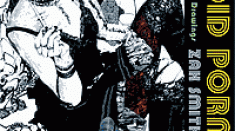
Zak Smith’s memoir We Did Porn is beautifully-produced by Tinhouse Books and it is a beautifully-written, readable book, featuring entertaining aphorisms and some sex stuff which might be titillating to people who are not me. A peculiarity of the book is the juxtaposition of absolutely brilliant cultural insights about the art world, the educated world, California, and the larger society . . . with really off-base gullible claims about the porn business.
Memoir is usually the process by which the writer imposes story on his or her life. In Los Angeles, memoirists depressingly often impose the tale of their descent into and return from addition as an overlay on their life stories. Zak Smith apparently does not particularly partake of the cocaine he mentions is pervasive in Porn Valley, so his memoir does not fall into the twelve steppers rewrite of existence and that is a plus for any Los Angeles memoir. Zak Smith makes it clear in his anecdotes about his experiences as a successful painter in New York that he doesn’t really like employing narrative structure in his art and he is aware of it. He seems to anticipate that someone might note the lack of narrative structure in his memoir. One of the most interesting things about the book is that Zak Smith does porn partly as artistic exploration and he is very aware of the meta nature of doing the thing to write about the thing.
Like me, Zak Smith (Zak Sabbath to his porn fans) comes out of the DC punk scene. Maybe this commonality is why his comments about California really resonate with me, but I feel like he has at least a really good East Coaster grasp of Cali. Zak Smith writes, “It’s not easy to know what’s going on in California . . . The people in charge are often trained actors, and two of its biggest businesses are aerospace — which is secret — and movies — which is lies . . . I’m from DC. DC punk bands are known for refusing to play ball. In New York, they’re known for trying to play ball, and failing, and then going back to not playing ball. SoCal bands are known for playing ball and being good at it and liking it and laughing at you. And then being on cable TV shows where they get tattooed.” Too true.
In We Did Porn, Zak Smith also writes about the peculiar mood society was in during the “zeroes” at the turn of the millennium. The best art explains something the viewer believes deeply to be true and expresses it in a way the viewer had not previously considered. Zak Smith’s deconstruction of the millennial culture of whiny BS is art; the first thing I thought reading it was that other people needed to read this too. He talks about how politics and news had gotten to the point where the disparate versions of reality presented were utterly incompatible with one another. He points out that the internet facilitated the creation and dissemination of antifacts. Zak Smith postulates that this cynical time lead to a sense that reality was slippery and indistinct, with blurred cause and effect. He writes, “People’s essential hopelessness made everything seem boring and they only talked about a topic if everyone could agree that it was stupid. Wit consisted of coming off as the least bitter complainer.” He describes reality television as offering “the thrill of finding yourself a victim of electoral fraud without the disappointment of realizing it might matter.” Most poetically, Zak Smith ruminates on zombie popularity, “In movies, zombies were the most popular monster. They are unusual, among monsters, for being inferior to their victims and winning only by weight of numbers, and for having no brains, but wanting to eat them.” A lot of the descriptions in We Did Porn reference this sort of slippery reality, stating maybe it is A or maybe it is not A, and this really works for the material.
The most amusing water cooler fact in the book is that the British Secret Intelligence Service used to use semen as disappearing ink. “Happiness writes white”, he says. I hope the semen thing is not an antifact because it is awesome.
Okay, I know the book is called We Did Porn and I haven’t really mentioned the porn part yet. The porn part is really odd to me. Zak Smith writes with wit and self-knowledge in so many areas, and I hesitate to call a memoir wrong in any way, but he just has many of his basic facts wrong on porn. Zak Smith effortlessly sees through the surfaces in the art world, but it is like he swallows whole every nonsense bullet point Porn Valley wants him to believe. When obviously intelligent people spew implausible marketing claims, I tend to assume that they are simply part of the astroturfing effort, but Zak Smith comes across more sincere and genuine than that. It’s just that some of his keen insight is blunted, when it comes to the porn industry, because it is predicated on faulty assumptions.
Most notably, he claims that porn is bigger than the mainstream movie industry and bigger than the automotive industry. Okay, a while back, an adult industry magazine told a newspaper reporter that the adult industry accounts for fourteen billion dollars of business gross every year. Many sources have repeated that the porn industry accounts for ten to fourteen billion dollars in the United States and fifty-seven billion dollars world-wide. Every year. First of all, these numbers are fictional. Playboy has a market cap of a hundred million and grosses about three hundred million a year. Even if you figure that Penthouse, Hustler, Vivid, and Private all do much bigger numbers than those, there is no way porn accounts for that much financial activity.
But let’s say, for some reason, we believe that porn moves $14 billion in the USA annually and $57 billion globally. Toyota has a market cap of one hundred thirty billion and an annual gross of more than two hundred billion. Ford has a market cap of twenty-three billion and grosses around a hundred fifty billion annually. Porn biz is not even a blip compared to the auto industry. It is more difficult to determine precise numbers for companies which produce non-porn movies, as many also sell alcohol or other fairly unrelated products, however I think Box Office Mojo is an excellent source for how movies are charting. They estimate around an average of ten billion in box office yearly and their site explicitly states that, “Box office tracking refers to theatrical box office earnings. Additional sources of revenue, such as home entertainment sales and rentals, television rights, product placement fees, etc. are not included. All grosses published reflect domestic earnings, i.e., United States and Canada, unless otherwise noted.” Heck, all told, with everything factored in, Transformers: Revenge of the Fallen alone might do more dollar volume than the entire global porn industry.
So the statements about the size of the porn business are the wrongest ones, but Zak Smith’s explanations of why people do porn are the oddest. He is not totally off-base on many of the motivations, some are insightful, and I’ll probably even write an article later about his intriguing statement that some people like to get paid for sex to evade responsibility for their actions. I laughed out loud at his awesome description of inviting a friend to BBQ and watch a samurai movie in his chapter entitled, “How do your friends talk to you after you start making porn?” This was familiar to me from how friends from school or other areas of my life sometimes treat me. (I’ll spare you all the porn vs. erotica, mainstream Porn Valley vs. independent counterculture debate for the moment.)
The book opens with Zak Smith writing about a disastrous Valentines Day date where the girl he is with has sex with someone else in the bathroom during their meal and then weeps extensively without explaining why and then posts about it online. He says that he loathes the uncertainty of dating; he hates not knowing what is going to happen. I saw Nina Hartley speak at a feminist conversation series a while back and she pointed out that the biggest attraction of porn for her was negotiated sex scenes. She likes to know what is going to happen and found that porn allowed her limits and activities to be comfortably defined beforehand. I don’t know Zak Smith, so I could be wrong, but I think he has the same reasoning as Nina Hartley on that motivation. Narrative structure would require that, having introduced the gun of hating dating in the first act, it would go off in the third act when explanations for why people perform in porn videos are offered. But narrative structure is not Zak Smith’s thing.
Full disclosure: To this day, Zak Smith and his girlfriend Mandy Morbid remain the only people to ever cite working with SuicideGirls as a reason they could not work with Blue Blood. People that Zak Smith and Forrest Black and I know in common, such as Voltaire, had mentioned a number of times that Zak Sabbath wanted to meet us. So I was surprised when Forrest Black and Zak finally met at the Young Hollywood party for Carlos Batts and then Zak said SuicideGirls wouldn’t let him do anything on the list of things I’d assumed he wanted an introduction for. Forrest Black and I actually shot and went to lunch with Voltaire during one of the stays at her home that Zak Smith mentions in his book, but Voltaire was irritated that Zak was trying to get her to do porn, when she’d already said no, so she didn’t invite him to lunch.
So I had an oddly wistful reaction to the We Did Porn memoir. A lot of it resonated with me and made me want to discuss parts of it. Zak and I both got liberal arts educations from high end New England schools, which we then turned to creative output, over-intellectualizing pop culture and underbelly. We both spent some formative years in the DC punk scene. I like the aesthetic he and Mandy Morbid present. But there is also a chasm of differences. All the big American mainstream porn video companies Zak Sabbath has worked with have asked me to direct for them and I’ve chosen not to do so. In fact, although there are certainly differences in our interests, despite the commonalities, the Venn Diagram of who he hangs out with and who I do still has surprisingly few people in common. I guess he plays for a different team.
When I started publishing Blue Blood in 1992 from the DC suburbs in Maryland, maybe I was just too new or too far away from Los Angeles, New York, and San Francisco to realize there were teams. Maybe the teams arrived with the internet. I don’t know. At the time, however, the best part of doing Blue Blood was the enormous access it gave me to interesting people. It makes me feel a bit melancholy that now doing Blue Blood sometimes throws up a wall instead. I don’t really understand how the teams are delineated or chosen. I think they handed out the rulebooks in Hollywood and I was in Rockville at the time and missed it. I don’t know if I ended up on the wrong team. Or Zak ended up on the wrong team. But he doesn’t seem like the sort of person who should be on a different team from the one I’m on, so I feel like somebody did something weird with the draft picks.
I feel like the lines must have been drawn all wrong. If someone would show me the map people are using, I think I might be able to figure out the flaw in the cartography.
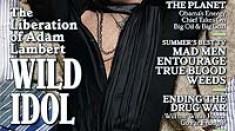
People keep asking me why I haven’t mentioned that Forrest Black and I have some of our photography of American Idol runner-up Adam Lambert in the current issues of Star Magazine and Rolling Stone, so I suppose I’ll mention it now. The internet has been abuzz for weeks now that Adam Lambert was going to “come out” in Rolling Stone issue 1081. So many publications were reporting that Rolling Stone was going to report that Adam Lambert says he is gay that Rolling Stone had to rush to put the digital image of the cover, lensed by brilliant top photographer Matthew Rolston, online well before the issue hit newsstands. Which seems very meta-something.
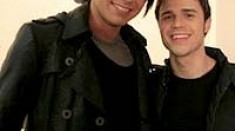
For some reason, a number of folks desperately wanted to be the primary source for settling speculation on Adam Lambert’s sexual orientation. Forrest Black and I photographed Adam Lambert kissing Brad “Cheeks” Bell. In point of fact, all of the supposedly scandalous images of Adam Lambert kissing a male were of him kissing the same guy, Brad “Cheeks” Bell. However, as many fans seems to find boy/boy smooching inconclusive and seemed to perhaps care about orientation, I didn’t want any part of anything which might hurt Adam Lambert’s chances of winning American Idol. I heart Alex Burton, my editor at Star Magazine, because the deal he and I made for the first round of images he ran was that there would be no outing of Adam Lambert in the issue and Alex Burton, my man of the Led Zeppelin tattoo, kept his word and kept the article classy and positive. Word is that Star Magazine offered Brad “Cheeks” Bell $2,000 to tell all and Cheeks declined, saying that he’d turned down higher dollar offers than that and he would only ever do a positive interview about Adam Lambert.
Unsubstantiated rumor is that Rolling Stone ponied up $50,000 for Adam Lambert to tell them his sexual preference first. Rolling Stone contributing editor Vanessa Grigoriadis, my fellow Wesleyan University alum, did a great job presenting Adam Lambert as a whole interesting person with visceral prose and probing but respectful questions. In the interview, Adam Lambert tells Vanessa Grigoriadis that he waited to come out in Rolling Stone because he felt he could express himself in context there. Some of the context, however, is that he didn’t lose his virginity (presumably to a man) until he was twenty-one and that he’d made out with girls while drunk at nightclubs and was now somewhat bi-curious about what it would be like to have sex with a woman.
Rolling Stone has always had some of the best, most incisive and most intriguing interviews of any magazine (and of course Wesleyan grads tend to be terrific writers), so it is no surprise this is a good one. But I’m left uncomfortable that the issue of a sexual label was such a big deal. I feel like we don’t have enough words to describe sexual orientation for the terms gay and straight to have much meaning.
If Adam Lambert suddenly got a girlfriend, after years of going out with the same sex, would that mean he did not count as gay any more? How about if he just occasionally fooled with really inspiring women who really got him as a person, but only had relationships with men? I realize that I travel in circles which are perhaps a bit ahead of the curve on sexual openness. But I know men who are gay-identified who sleep with women from time to time. I know women who are bi-identified who only have relationships with men but also have sex with women. I know men who are straight-identified who will have sex with men provided there is a sexual configuration of enough people for it to count as an orgy. Everyone can think of the prison example for same sex relationships among people who do not identify as gay or lesbian. Etc. I think that maybe 10% of the population is strongly hardwired to enjoy only the same gender and maybe 10% of the population is strongly hardwired to enjoy only the opposite sex. But most people, in the right situation, are more fluid than that. They might have a preference, even a strong preference, but, in the right situation, the preference won’t dictate their actions.
At any rate, I feel most human sexuality is too complex for a tidy label to be genuinely descriptive. I thought it was cool that Adam Lambert told Vanessa Grigoriadis and Rolling Stone, “I loved it that this season girls went crazy for me . . . As far as I’m concerned, it’s all hot. Just because I’m not sticking it in there doesn’t mean that I don’t find it beautiful.” There is a certain combination of flamboyance and rawness there which is the reason so many of my friends were rooting for Adam Lambert on American Idol.
And it is a flamboyance and rawness which utterly transcends sexual orientation. I think that general America is far more afraid of that rock star counterculture essence than they are of male homosexuality. Senior Blue Blood writer Will Judy made the excellent point that, although Adam Lambert was runner-up to Kris Allen, rather than winner, on American Idol, “Lambert got to live my ultimate superdream from 5th grade though. Fronted Kiss AND Queen in the same night. (And KILLED, of course)” which is a really fine summation.
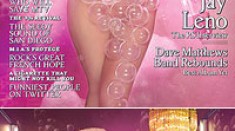
Singer/songwriter Lady GaGa appears on the cover of the current issue of Rolling Stone. The cover is shot by photographer David LaChapelle. David LaChapelle has shot many Rolling Stone covers, is known for his bright colors and elaborate sets, and started in photography taking naked pictures of club kids. Lady GaGa went to an Upper West Side high school and became a New York club kid. Maybe I am biased because I enjoy Lady GaGa’s work and I enjoy David LaChapelle’s work and I’ve spent a fair amount of time inside edgy nightclubs, but I don’t get what all the fuss is about.
Rolling Stone has certainly run nakeder covers than the Lady GaGa one. Anyone remember the full nude of model Laetitia Casta on a bed of petals? It is not like you’d find artistic nudes likes these on PukingOnPenis.com. Seriously don’t click that, but you get what I mean. Today, in a world where all sorts of depravity is a click away, why does a teensy bit of authentic club culture make so many people hyperventilate?
Although a certain sort of bohemian club culture has existed since time immemorial and that artistic counterculture has always made some people uncomfortable, is it really that big a deal? Or is the problem that we have come to expect pop stars to be the best-looking possible actresses hired by management teams with songwriters and stylists and something which came about more organically now seems wrong? Lady GaGa is widely credited as having written on songs for Akon, Britney Spears, Fergie, Pussycat Dolls, and oddly enough New Kids on the Block. Although I’m not sure how or if Lady GaGa is credited in ASCAP, I’d be happier if I could find her songwriting credits. Still, I tend to believe that she actually writes songs. Even if you don’t find bluffin with one’s muffin as entertaining as I do, surely the combination of artist and performer is still better than solely artist or solely performer. At the very least, it is not worse, is it?
From my point of view, the most controversial thing about the David LaChapelle Rolling Stone cover featuring Lady GaGa is that New York fashionistas credit the whole bubble outfit look to designer Hussein Chalayan. Although neither a bubble dress or bubble corset appear on the web site for Hussein Chalayan’s 2007 collections, I’ve seen credible photos from his runway show stuff for that year. The designer was reportedly disappointed that Lady GaGa knocked off his design, rather than wearing the original.
So, if you’d like to recreate Lady GaGa’s Rolling Stone look, you now know where to commission your own bubble outfit, if you don’t feel crafty enough to make one. Then all you have to do is round up a bunch of your naked and barely-clad friends and get wet and messy. Photos optional.
If you are alt-identified, yet want Kris Allen to beat Adam Lambert in this week’s American Idol finale, then you are complicit in your own oppression. Rebels who want Adam Lambert to lose must just hate themselves.
People like to fuss about sex and sexuality, but the place where Adam Lambert is actually unusual is that it is rare to see new musicians with serious larger-than-life star quality in the spotlight today. I just watched a top 20 video countdown and Eminem was just about the only one who would turn heads in a room he walked into, on force of presence alone. So it is exciting to see someone who has the right counterculture vibe with a mix of subcultures gothic, punk, hard rock, rockabilly, emo, scene and more blended together for something unique and compelling. To anyone who states people like Adam Lambert are a dime a dozen and FOX is just not in-the-know, I have to say there are a lot of people with some of that general sort of style, but not a lot with that vibe and that level of both charisma and musical talent.
To receive the same kudos as someone who comes across more normal and mainstream, I often feel like I have to work at least twice as hard and produce work which is twice as good. I would be fine with this, except for the part where the whole process plateaus early. Allow me to explain. In a way, simple badges of flamboyance and theoretical nonconformity, such as tattoos or unnatural hair color, have become fairly common by 2009. Someone who truly has an artistic and offbeat spirit is still likely to have to be better than the next guy to achieve the same recognition. Unfortunately, people, who identify as somehow alternative or creative or freaky, tend to want to root for the underdog. This means that, as soon as one of their compatriots is about to come over the top and succeed for real, they get an enormous backlash from former supporters. So I see all these people, who were super excited by Adam Lambert’s early successed on American Idol, who are now not into him because he is perceived as the obvious front-runner; they think maybe they like the other final two member Kris Allen because he is the underdog.
Kris Allen is an appealing enough performer. In particular, I liked his performances of “She Works Hard for the Money” and “Heartless”. I most likely would not flip the channel if a music video of his came on. I actually think American Idol fans got it exactly right for the AI8 final two to be Kris Allen and Adam Lambert. (Alison Iraheta might be more demographically similar to Adam Lambert, but Kris Allen is a more ready-for-primetime performer.) Kris Allen is not the underdog to win this contest because he is somehow disadvantaged and just needs a little love and support. Kris Allen is not some sort of stray spaniel puppy in need of a home. Kris Allen is the underdog to win the American Idol competition because Adam Lambert deserves it far far far more than he does. Some of the web chatter about the final American Idol vote suggests more that people want to vote against Adam Lambert for being successful more than they want to vote for Kris Allen for any positive reason.
Opinionated and forthright judge Simon Cowell has stated in interviews that he would like to see Adam Lambert win. Led Zeppelin does not normally permit American Idol to use their songs, but they gave permission for Adam Lambert to sing “Whole Lotta Love”. U2 does not normally permit American Idol to use their songs, but they gave permission for Adam Lambert to sing “One”. When Slash from GNR mentored the Idols, he posted to his Twitter that he was especially impressed by Adam Lambert. When Katy Perry performed on the show, the legend on the back of her Elvis cape read “Adam Lambert”.
It seems like if Simon Cowel, Paula Abdul, Robert Plant, Bono, Slash, Katy Perry, and a host of other notables all feel strongly that Adam Lambert should win American Idol, then he should be a shoo-in sure thing. But he is not. The reason he is not is that inexplicably hot people with smudgy eyeliner and leather jackets and big boots hate themselves. Now nonconformity does tend to get push-back from the overculture, so I understand why many bohemians do not necessarily expect to always get praise. Getting praise, however, does not mean that you lose your individuality merit badge. You should expect to be able to win people over, when they see what you are really like.
No disrespect at all to Kris Allen, but Adam Lambert deserves to win American Idol. Adam Lambert earned the win. I know, I know, rebels figured out that 19E and the powers-that-be want to have Adam Lambert win, so it would be (oi oi) rebellious to vote for Kris Allen instead. A good rebel is ready to take the power, not just cry like a baby over whoever seems to be an authority. Voting against Adam Lambert is not sticking it to the man; it is just building a glass ceiling for your tribe. Hopefully Wednesday night still ends up being a coronation for Adam Lambert.
If you live on the West Coast like me, it is not too late to get free ice cream from Ben and Jerry’s today. Southern California has been having a crazy heatwave. I confess to worshiping at the alter of frosty central air conditioning, but I had to leave the house yesterday to get espresso beans for iced lattes and was stunned at how fast it has gone from chilly to insanely hot this year.
I guess this is the part where I should probably deconstruct the ways in which all strata of counterculture are marketed to disingenuously most of the time. I could talk about how people think there are these two hippies Ben Cohen and Jerry Greenfield who built an ice cream empire subsisting on a shoe-string budget, making strongly flavored ice cream according to their own personal quirky stoner tastes, and serving it in an old gas station. I could talk about the ferocious rivalry between Ben and Jerry’s and Häagen-Dazs and how Häagen-Dazs attempted to keep Ben and Jerry’s out of their distribution channels and Ben and Jerry’s repeatedly sued Häagen-Dazs and started a whole PR campaign with the slogan, “What’s the Doughboy afraid of?” If you are wondering where that slogan came from, the answer is that Häagen-Dazs is owned by Pillsbury, or at least was at the time, and Ben and Jerry’s was this indie force fighting The Man. Of course, Ben and Jerry’s sold to Unilever in 2000. The multi-billion dollar Unilever is the largest ice cream manufacturer in the world and owns, not only Ben and Jerry’s, but also Breyers, Popsicle, Slim Fast, Klondike, and dozens of European subs of Heartbrand. Hippie Ben and Jerry’s now are to corporate ice cream what marketing tool female mascots are to corporate so-called “altporn”, in that they make public appearances and do the occasional press junket, but it’s just for show and they don’t actually have any, ya know, business role in the company. Oops, I digress. I mean, FREE ICE CREAM!
The original founder’s of Ben and Jerry’s purportedly marked their first anniversary of struggling to stay in business by giving away free ice cream cones for a day. Today the company turns thirty-one years old and almost all Ben and Jerry’s locations are giving away free cones. I’m guessing they really have celebrated their important anniversaries by giving away free ice cream cones.
Hey everyone, we are “Hollywood’s most dark and offbeat counterculture” according to FOX News. Not that we haven’t been on various FOX shows online and on television a number of times, but I thought I’d share.
There are a couple of things which bother me about this piece, but they are probably only a thing to me and like six other people, and it’s always nice to be recognized. Then again, a segment about why Lindsay Lohan and Samantha Ronson are splitsville follows.
And I’m pleased the Adam Lambert coverage was not negative. I’m saying no to anyone who contacts me wanting to do any sort of hit piece using the photos Forrest Black and I shot of Adam Lambert. We even got Star Magazine to play nice in their article about him and that doesn’t happen every day.
By next week at the latest, I plan to stop compulsively watching political news for a while and get back to morbid and funny vampire and angst television, fall movies, non-political social commentary, entertaining misbehavior, music and hot naked counterculture. This week, however, even South Park is still hyped up about politics and the election. South Park tonight featured adults partying drunk in the street with beer kegs and Stan and Kyle calling in a noise complaint to the cops. The expressions on the two kids’ faces and the appalling soundtrack the grown-ups select is priceless.
It featured a kinda dumb riff on Oceans 13. After fast-forwarding through parts of Oceans 12 before determining it to be unwatchable, even at high speed, I passed on the movie they were spoofing, which left some entertainment value out for me there. South Park’s emergency room scene was amusing, with suicidal McCain supporters and Obama supporters who partied too hard.
I think having both the presidential election the USA just had and the referendums we just had, the country is at least either a little hyper-adrenalized or a little hung-over. I’m really hoping that, when California finishes tallying up all the provisional ballots and suchlike, the moronic Prop 8 will somehow not have passed. In general, the results of the referendums are all a little surprising. It appears that pro-life/anti-abortion measures all failed. It appears that anti-gay measure all succeeded, including referendums on both marriage and adoption. I’m sure kids bouncing from foster home to foster home are thrilled that they won’t be getting taken in by any loving families which are not 100% traditional. Or not. Additionally, marijuana got a lot more legal in a number of states. And Washington appears to have legalized doctor-assisted suicide.
So it is a weird morning and it probably makes sense that everyone is feeling a little jumpy today, no matter how overjoyed they were last night, as the results came in. At any rate, you can watch the most recent episode of South Park for free online now on at this link.
Last week, the Dead Kennedys announced an indefinite hiatus from touring, due to health issues suffered by bassist Klaus Flouride and drummer D.H. Peligro. Although I was fangirl-thrilled to meet East Bay Ray at a coffee shop a couple years back, I personally find it depressing when bands tour without key original members. A Jello Biafra-less DK would just bum me out.
Sometimes a group of people come together to make a great creative team, but only small portions of the group are really driving forces. The DK thing is not really one of those disputes. Drummers sometimes spontaneously combust and that never makes it seems like a band should hang it up. I think the thing which bothers me the most about Jello Biafra not exactly being in the Dead Kennedys any more is that you know there was a hot moment in time when they must have felt like a galvanized special unit in the war against conformity and oppression. There must have been a time when the Dead Kennedys felt like they could take on the world . . . together.
For anyone who is unaware of the legal squabble, the Dead Kennedys had a falling-out partly over whether or not their songs should be licensed to sell various things. Most notably Levi’s wanted to use “Holiday in Cambodia” in a Dockers commercial and Jello Biafra rejected their advances without consulting the rest of the band. Lawsuitarity ensued. Levi’s did not get the song, but Alternative Tentacles is no longer allowed to sell full length DK products. I am torn on how I feel about that. I have lived in not one, but two, punk rock group houses named after the “Holiday in Cambodia” song. Not like thirteen punks living in a townhouse had to get a license to call the place Cambodia, so maybe we only helped by buying cassette tapes and T-shirts, but we would not have considered Levi’s to be, ya know, punk.
On the one hand, I feel like there should be more benefit to artists who create important seminal works. On the other hand, I am uncomfortable with certain types of mainstream corporate interests co-opting and diluting counterculture. It seems like there have to be ways to monetize art without giving it to a company who would demean its original purpose. The Dead Kennedys MySpace page announced this spring that Give Me Convenience or Give Me Death had managed to go gold in both the USA and the UK, without major label support. Keeping in mind that Give Me Convenience or Give Me Death came out in 1987, I’m guessing it hasn’t been buying mansions in the meantime.
So maybe nothing pure can last without pain, but here is a video shot at a 1981 Dead Kennedys (with Jello Biafra) performance of “Too Drunk to Fuck” in Finland. And, as you probably got from Blue Blood board members Buster Friendly and Mr. Karl’s posts, if you did not know it already, the Buckcherry “Too Drunk to Fuck” is not a cover of the DK song, any more than the Katy Perry “I Kissed a Girl” is a cover of the Jill Sobule tune. The Finnish video may be amateur, but it is complete with punk rock snogging.
Corporate Goth is a familiar expression in East Coast cities where people tend to separate their playtime from their workdays. I was living and working mostly in Washington, DC and Baltimore when I founded Blue Blood in print. I did primarily contract design work and most of the companies I worked for were conservative federal contractors, management consultancies, and lobbyists. My hairstyle at the time consisted of only natural colors, albeit definitely not colors which would appear striped together in nature. On my own time, I believed that shirt was spelled L-I-N-G-E-R-I-E. Heck, one of my neighbors harangued me from across the street, telling me I belonged in a whorehouse for what I wore just to clean my car. (I called the cops on her.) But, when I was seated at a computer in someone else’s place of business, I might not have looked like the most standard employee (or contractor). My clothes might have tended towards a darker palette and my hair was not really a businessperson’s cut, but it was usually businesslike enough. (When I worked at EDS, my manager did complain to my agency about my sexy stockings.)
This might go without saying, but I’m going to state the obvious here: I read a lot of cyberpunk at the time. I loved William Gibson and John Shirley and Richard Kadrey and Norman Spinrad and Pat Cadigan and Walter Jon Williams and George Alec Effinger and of course Bruce Sterling’s Mirrorshades anthology was seminal. The list goes on, but one of the salient points of the emerging cyberpunk genre at the time was that it acknowledged both street culture and corporate culture. Cyberpunk was, in many ways, first and foremost a sociological study of how the human need for tribalism might manifest itself in a future with new technology.
So there were the heavily modded post-human gothic and punk tribes with writhing tattoos and tusks and animal muscle grafts and music implants in their ear drums. But there were also the sleek corporate melds of gangsterism and business core values. I don’t know how it was where you lived, but, where I was, both styles had a real appeal to counterculture people striving to achieve their personal goals and power, despite preferences for rebellion and individuality and flamboyance. This is where Corporate Goth comes from. The whole steampunk fashion thing sort of built on and evolved from some of this scene as some of the cyberpunk authors started writing steampunk and Neal Stephenson burst onto the scene. But the evolution of steampunk is another article.
In Los Angeles, many of the sleek black business stylings of corporate goth are just dressed for a certain sort of meeting. This is aesthetically pleasing to me, but it removes some of the tribal appeal.
Xian (pronounced “zigh-ahn” despite my stupid left hand always trying to add a letter t) Vox is not your typical Los Angeles promoter and DJ. She is interested in varied philosophies and works tech industry day jobs. So it sort of makes sense that she would like a corporate goth theme. A much smaller percentage of Los Angeles denizens who like spooky nightclubs have ever worked a corporate job . . . at least a much smaller percentage than it cities where it is common to be at least as interested in books as in movies, at least as interested in the heart and mind as the body.
So, anyway, Xian did a Hex VIP event as a run-up to a larger ball and Blue Blood were media sponsors of the event. I did not ask Xian what her reasons or inspirations or motivations were, but one of the possible themes for the event was Corporate Goth. So here are the gothic photos Forrest Black and I shot at the event. If you might have otherwise wondered at quite what the theme was, now you know. Unless, of course, you didn’t read this and just went straight to the pics. I think everybody looks really great, so enjoy.